
BestOnlyFans publishes ranking cards built from crawled profile data, and that data has an age. This article explains how to read freshness signals in ranking data decay so you can tell whether a displayed price, activity count, or category tag still reflects reality. The core problem is simple: ranking sites capture creator details at a fixed moment, while creators change prices, posting habits, and promotions on their own schedule. When those two timelines drift apart, the card misleads even though nothing on the page looks broken.
It is a snapshot, sometimes hours old, sometimes weeks old, and the gap between snapshot and now is where bad subscription decisions get made. BestOnlyFans refreshes its rankings every month.
How Ranking Site Data Collection Cycles Work
Ranking sites run crawlers on schedules, and each schedule imposes a delay between a creator’s change and the card’s update. A price change made on a Tuesday might not appear until the following Monday. During that window, every visitor who trusts the card is planning a subscription around a number that no longer exists.
Crawl frequency varies by data type because collecting different fields costs different amounts of effort.
| Data Type | Typical Crawl Frequency | Subscriber Impact if Stale |
|---|---|---|
| Automated price scraping | Daily to weekly, depending on site resources | Budget planned around an expired promotional rate or a base price that has since increased |
| Manual creator profile updates | Weekly to monthly | Category tags and bio claims misrepresent what the creator currently publishes |
| Subscriber-reported feedback | Irregular, event-driven | Corrections lag real changes by days or weeks, so recent shifts stay invisible |
A card can be perfectly current on price and badly outdated on category. Reading freshness means checking each field you care about rather than trusting the card as one uniform object.
Visual Indicators of Fresh versus Stale Rankings
Most ranking sites leave clues about data age, but the clues are easy to skip when you are scanning quickly. Some use a color-coded dot, a recently updated badge, or a small note from the creator about changes. Absence of any marker is itself a signal: an unlabeled price could be from this morning or from last quarter.
Freshness markers are not decoration. Those markers tell you how much confidence to place in the number beside them. When a card shows a timestamp from three days ago and a price that seems low, the timestamp is the more trustworthy element.
- Explicit timestamp printed directly on the price field
- Color-coded update indicator that changes with data age
- Creator note describing a recent price or content change
- Cross-reference link pointing to a verified social media profile
- Absence of promotional pricing that matches a currently running creator campaign
- Subscriber count trends that stay consistent across multiple ranking periods
It is simply unverifiable, and unverifiable data deserves a verification step before it influences spending.
If a ranking card shows no timestamp and no update badge, treat every number on it as a claim rather than a fact, and confirm the subscription price on the creator’s own page before entering payment details.
Price Discrepancies as Primary Decay Alerts
Price is the field subscribers check first and the field that decays most visibly. Paid subscriptions run from $4.99 at the minimum to $49.99 at the maximum, with most paid pages clustering between $4.99 and $15. When a card displays a number outside that pattern, or a number lower than the platform minimum, suspect decay rather than a bargain.
A creator can legitimately run a $3 first month even though base prices may not fall below $4.99. Once that promotion ends, the card may keep showing $3 until the next crawl. The gap between promotion end and card update is where subscribers get surprised at checkout.
| Displayed Price | Actual OnlyFans Price | Likely Explanation |
|---|---|---|
| $3 first month | $9.99 base subscription | Card still shows a promotional rate that ended when the campaign schedule closed |
| $4.99 | $12.99 base subscription | Card predates a creator price increase, and auto-renew terms have already shifted for existing subscribers |
| Free ($0) | $7.99 paid subscription | Card reflects an obsolete free tier from before the creator converted to a paid page |
When a creator raises the price, auto-renew stops for existing subscribers, and access lasts until the paid period ends. That mechanism means a stale card can mislead in two directions at once: it understates what new subscribers will pay and overstates how long current subscribers keep their rate.
Card verification holds of $0.10 appear on some payment flows and are refunded within days. A $0.10 charge on a statement is not a subscription price and should not be read as one.
Activity Metrics That Degrade Faster Than Others
Posting frequency and promotional pricing change quickly because creators control them directly and adjust them often. Historical pricing averages barely move at all and stay useful across quarters. Understanding decay speed tells you which numbers to double-check and which to accept.
- Recent post counts decay fastest and can mislead within days of a crawl
- Promotional pricing becomes invalid the moment the campaign schedule ends
- Subscriber growth rates drift weekly as creators run and pause promotions
- Content category tags update monthly and lag behind gradual format changes
- Historical pricing averages remain reliable across multiple quarters
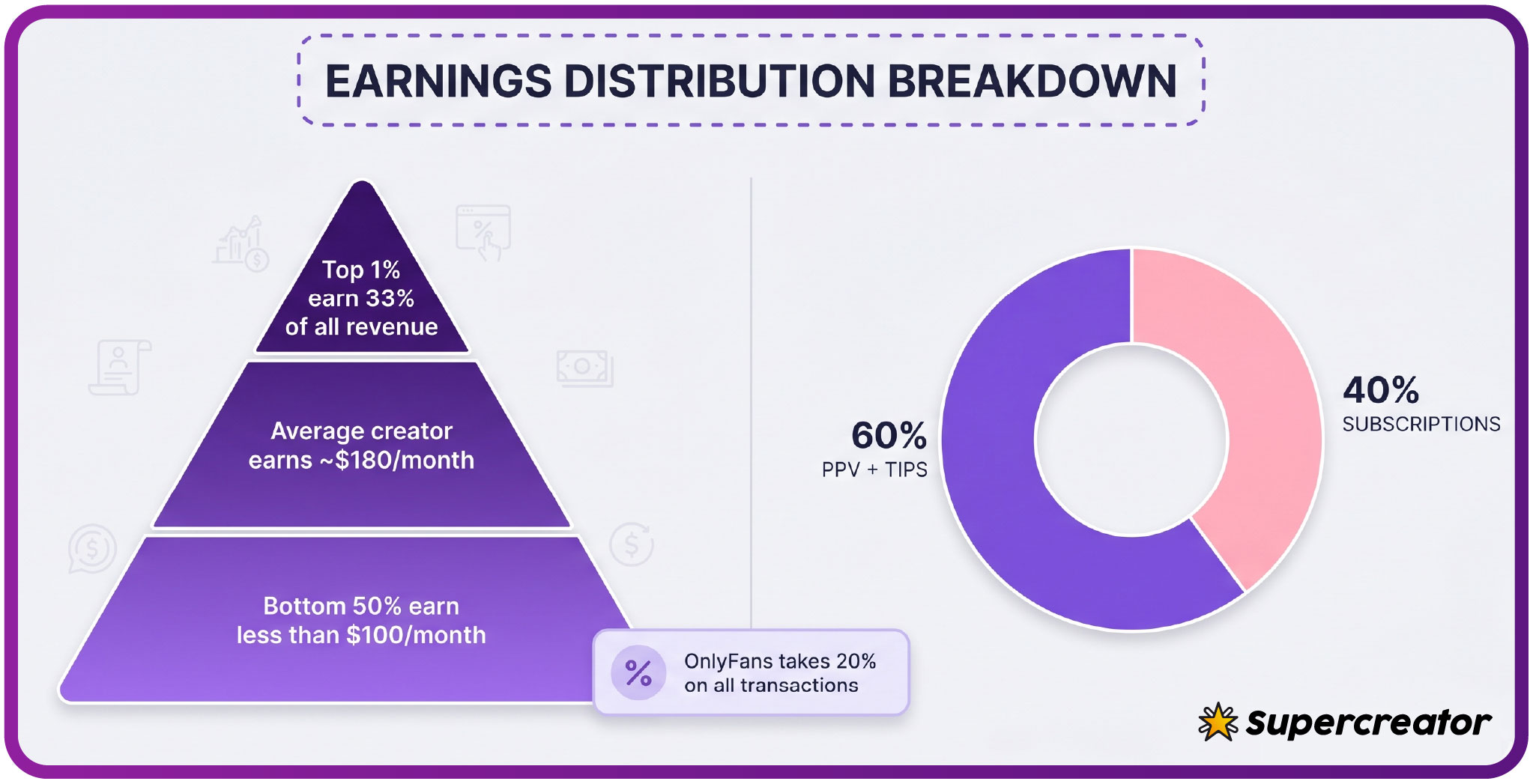
OnlyFans takes a 20% fee on everything and creators keep 80%, so a creator’s willingness to discount depends directly on how that split affects their net. When a promotion ends, the base price returns, and the ranking card is the last place the change shows up.
Cross-Verification Tactics Before Subscribing
Verification does not require spending money. The goal is to confirm the two or three fields that matter for your decision, then subscribe with accurate expectations. A few minutes of checking prevents a month of paying a rate you did not agree to.
Start with the creator’s linked social media, which usually announces price changes before any ranking site notices them. If the creator offers a free tier, that tier shows the current paid rate directly. Comparing two independent ranking sites catches crawler errors that a single source would hide.
- Check the creator’s linked social media for recent activity and price announcements
- Use a free OnlyFans tier, when available, to view the current subscription rate
- Compare across two independent ranking sites and look for consensus
- Examine subscriber review dates and discard feedback older than a few weeks
- Watch live streaming schedule indicators, which reveal whether the creator is active now
One practical note on payment discretion belongs here as well. Readers who want the best way to hide onlyfans purchase on a shared statement should still verify the price first, because a masked charge you did not expect is harder to dispute than one you planned for.
BestOnlyFans Specific Freshness Methodology
This ranking service handles data age with four visible mechanisms rather than one hidden crawl.
- Automated crawls run on stated intervals so readers know the maximum possible lag
- Manual verification flags mark top-ranked pages that staff have confirmed by hand
- Confidence scoring is displayed per data field, so a fresh price and an aging subscriber count carry different weights
- Historical version archiving shows previous states of a card, which lets you see whether a price moved or simply stopped updating
These four elements exist because the platform has no built-in discovery feed or directory. Ranking sites fill that gap, and a ranking site that hides its data age is not filling it well. Methodology transparency is the feature that separates a usable ranking card from a decorative one.
How to Read Confidence Scores
A confidence score attached to a field tells you how recently that specific number was captured. High confidence on price with low confidence on subscriber growth is normal and useful. Read the score per field, never as an average across the whole card.

Budget Adjustments When Rankings Prove Outdated
The subscription budget you set based on a stale number can usually be redirected to a creator whose current price you have confirmed. Nothing about a decaying card changes what you can afford, only where the money goes.
Two or three notes about the same ranking site showing outdated prices tells you more about that site’s reliability than any badge it prints.
- Withhold the immediate subscription until you verify the current price
- Reallocate the planned spend to a verified creator with stable, confirmed pricing
- Adjust your PPV reserve using actual pricing rather than the displayed figure
- Document the discrepancy so you can judge that ranking source later
Budget planning also needs to account for the payment types that sit outside the base subscription. PPV messages unlock up to $50, paid chat commonly runs $3 to $5 per message, and tips can reach $100. A stale card that shows the wrong base price will usually show stale figures for these secondary costs too, so recheck them at the same time.
Free pages deserve separate handling. They set the base price to $0 and earn through PPV messages and tips. A card that lists a free page as paid, or a paid page as free, has almost certainly missed a conversion event, and every other field on that card should be treated with matching suspicion.
FAQ
How often does this ranking service refresh its price database?
Price fields are refreshed on the crawl interval stated in the card’s methodology notes, which is typically daily to weekly. Exact timing varies by page, so read the timestamp on the specific card rather than assuming one schedule applies everywhere.
Why would a ranking site show a different price than what’s on OnlyFans?
Most often because a promotion ended or a creator raised the base price after the last crawl. The card captured an older state and has not been re-crawled yet. It can also happen when a free page converts to paid, or the reverse, since those events change the base price completely.
Can I trust subscriber counts on ranking cards if the price is wrong?
Not without checking further. Price errors and subscriber count errors usually share the same cause, which is a stale crawl. If one field is outdated, assume the neighboring fields are roughly the same age and verify anything that affects your decision.
What should I do if two ranking sites show conflicting information?
Treat the newer timestamp as more reliable, then confirm directly on the creator’s page or linked social media. When both sites lack timestamps, neither is trustworthy for that field, and the creator’s own page becomes the only source worth acting on.